Heavy-Duty Conveyor Chain Wear in Cement Plants: Material, Heat Treatment, and Verification
Wear is a system problem, not just a hardness number
In cement plants, heavy-duty conveyor chains fail through a combination of abrasion, adhesion, fatigue, and corrosion. The dominant mechanism depends on the duty: bucket elevator chains see high-speed cyclic loading and abrasive dust; clinker conveyor chains handle hot, coarse, impact-prone material; heavy-duty conveyor chains in reclaim and transport service face low-speed, high-load abrasion. Material and heat treatment choices must match the mechanism, not just a generic “hardness” target.
This guide explains how those mechanisms work, how material and heat treatment influence them, and how to verify chain condition and supplier claims before and after purchase. It is written for engineers and technical procurement teams evaluating replacement or new chain for bucket elevators, clinker conveyors, and heavy-duty conveyor systems.
Wear mechanisms in cement plant chain service
Abrasive wear
Clinker, limestone, and cement dust are hard and angular. When these particles enter the pin-bushing clearance or the roller-plate interface, they act as a third-body abrasive. The result is material loss on pins, bushings, and rollers, which increases clearance and eventually changes the chain pitch. Abrasive wear is usually the leading life limiter in clinker conveyor chains and bucket elevator chains handling dusty material.
Hardness helps, but only if it is achieved without excessive brittleness. A through-hardened pin that is too brittle can fracture under shock loading before it wears out. Surface hardening can improve abrasion resistance while retaining a tougher core.
Adhesive wear and galling
Under high load and low sliding speed, metal-to-metal contact can cause adhesive wear, especially if lubrication is marginal. In heavy-duty conveyor chains and reclaimer chains, pin-bushing surfaces may gall or scuff. Surface finish, lubricant retention, and material compatibility matter here. Heat treatment that leaves a clean, consistent surface and appropriate hardness differential between pin and bushing can reduce adhesive wear.
Fatigue
Bucket elevator chains operate at relatively high speed with cyclic tension. Fatigue cracks can initiate at stress concentrations such as plate holes, pin grooves, or surface defects. Heat treatment affects fatigue life through microstructure: a fine, uniform grain structure and controlled decarburization improve fatigue resistance. Over-hardening or poor tempering can reduce toughness and accelerate fatigue failure.
Corrosion and elevated temperature
Cement plant environments can be humid or chemically aggressive, and clinker can be hot. Corrosion reduces effective section thickness and can initiate cracks. At elevated temperature, tempering resistance matters: a chain that loses hardness at operating temperature will wear faster. For clinker conveyor chains, confirm the expected temperature range and whether the chain material and heat treatment are suitable for it.
Material selection: what matters for each chain type
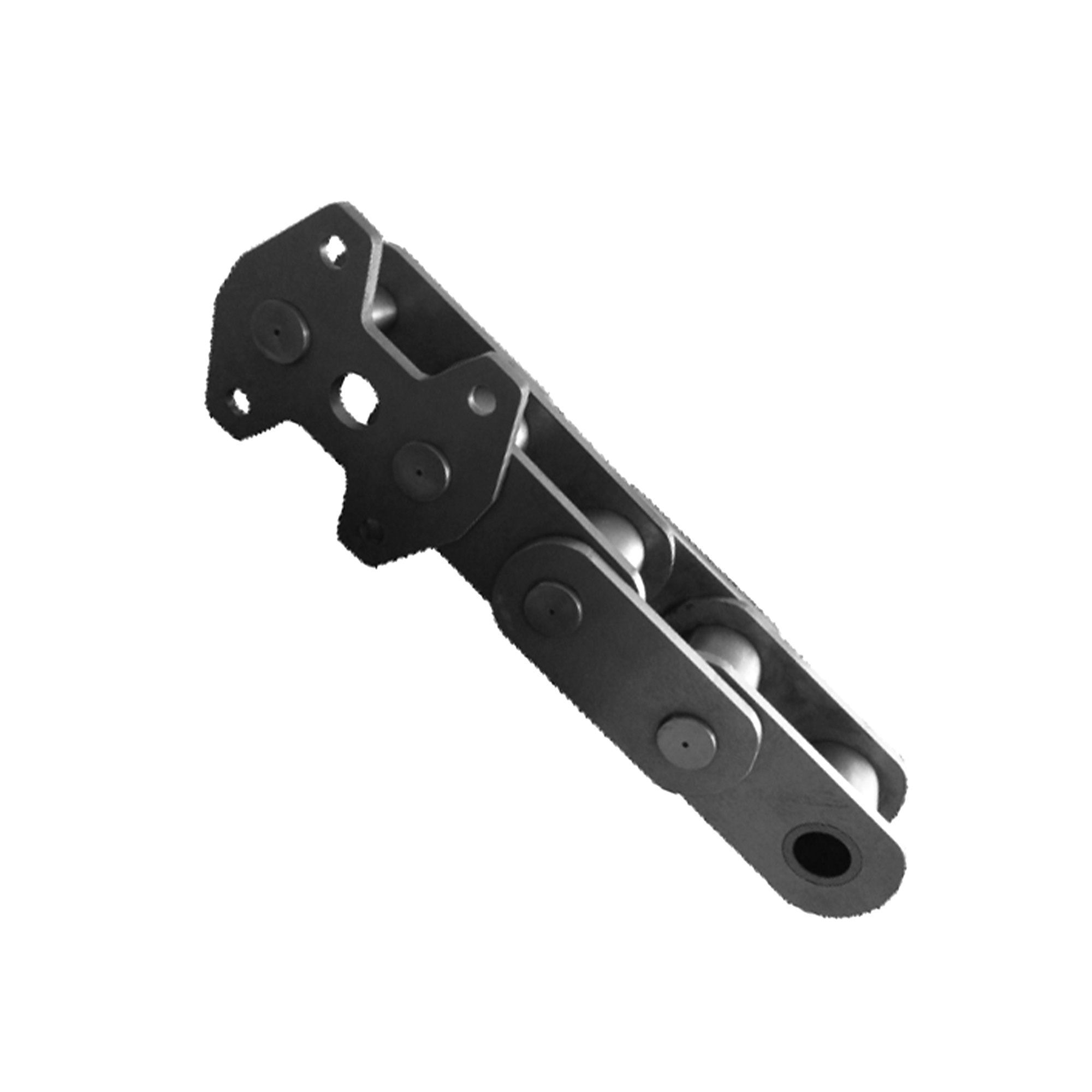
Most heavy-duty conveyor chains are made from alloy steels, with pins, bushings, and rollers often using different grades and heat treatments to balance wear resistance and toughness. The table below summarizes typical considerations; exact grades and treatments must be confirmed with the supplier for the specific duty.
| Chain type | Dominant wear mechanism | Material/heat treatment focus | Verification priority |
|---|---|---|---|
| Bucket elevator chain (e.g., NSE series) | Fatigue, abrasive wear, adhesive wear | Uniform microstructure, controlled decarburization, toughness with surface hardness | Hardness profile, fatigue test records, dimensional consistency |
| Clinker conveyor chain (e.g., SCD, SDB series) | Abrasion, impact, elevated temperature | Wear-resistant surfaces, tempering resistance, toughness for impact | Hardness at temperature, impact toughness, pin-bushing clearance |
| Heavy-duty conveyor chain (large pitch, low speed) | Abrasion, adhesive wear, bending fatigue | Deep hardening, consistent pitch, pin-bushing hardness differential | Pitch accuracy, hardness uniformity, surface finish |
For bucket elevator chains, the product evidence lists NSE and NSE-W series for heavy-duty, high-speed lifting duty. For clinker conveyors, SCD forged clinker and SDB series are listed. These series designations indicate the intended duty range, but they do not by themselves prove material or heat treatment suitability; request the actual material and heat treatment specification for the series you are considering.
Heat treatment: mechanisms and failure modes
Heat treatment determines the final microstructure and therefore the balance of hardness, toughness, and residual stress. Common processes for chain components include through-hardening (quench and temper), case hardening (carburizing or carbonitriding), induction hardening, and stress relieving.
- Through-hardening is used for pins and bushings where a combination of core toughness and surface hardness is needed. The tempering temperature controls the final hardness and toughness. Under-tempering leaves excessive brittleness; over-tempering reduces wear resistance.
- Case hardening produces a hard surface with a tough core, often used for pins and rollers in abrasive service. Case depth must be sufficient for the expected wear life but not so deep that it embrittles the part.
- Induction hardening can harden selected surfaces such as roller paths or pin ends. It requires careful control to avoid cracking at the transition zone.
- Stress relieving after welding or machining reduces residual stress that could lead to distortion or cracking in service.
Common heat treatment failure modes include decarburization (soft surface layer), quench cracks, insufficient case depth, and non-uniform hardness. These are not always visible on a new chain, which is why verification testing matters.
Verification before purchase: what to ask and test
Verification should combine document review, dimensional inspection, and material testing. The depth of testing should be proportionate to the criticality of the chain and the size of the order.
Documentation and traceability
- Request material certificates for pins, bushings, rollers, and plates, with heat numbers traceable to the finished chain.
- Request heat treatment records: process type, temperature, time, and tempering parameters. These records should be specific to the production lot.
- Confirm the applicable standard or internal specification for dimensions, tolerances, and testing. If a standard is claimed, ask for the standard number and the test report referencing it.
Dimensional and visual inspection
- Measure pitch over a defined number of links and compare to the specified tolerance. Pitch variation can indicate uneven heat treatment or assembly.
- Check pin and bushing diameters, plate hole sizes, and roller dimensions.
- Inspect for cracks, decarburization (often visible as a soft, light-colored layer on a polished cross-section), and surface defects.
Material and hardness testing
- Hardness testing on pins, bushings, and rollers at multiple locations. A single reading is not enough; look for uniformity.
- Microstructure examination on a sample to confirm grain size, decarburization depth, and case depth where applicable.
- For critical applications, fatigue or impact testing may be warranted. Agree on the test method and acceptance criteria before production.
Third-party inspection can be useful for large orders or when supplier records are incomplete. The cost should be weighed against the downtime risk of premature chain failure.
In-service monitoring and failure analysis
Verification does not end at delivery. Regular inspection can catch wear before it causes unplanned stoppage.
- Track chain elongation (pitch growth) at fixed intervals. A common rule is to replace when elongation exceeds the manufacturer’s limit, often around 1.5–2% for many conveyor chains, but confirm the limit for your specific chain and application.
- Measure pin and bushing wear, and check for loose or seized rollers.
- Look for corrosion, cracking, and plate deformation.
- Record operating hours and load to correlate wear with duty.
When a chain fails, examine the fracture surface and wear pattern. Abrasive wear leaves smooth, polished surfaces; fatigue shows beach marks; adhesive wear shows scuffing and material transfer. The pattern helps identify whether material, heat treatment, lubrication, or operating conditions are the root cause.
Purchasing decisions: matching chain to duty
Use the following decision rules when specifying or replacing chain:
- Define the duty clearly: chain type, pitch, load, speed, temperature, material handled, and environment. For bucket elevators, specify whether the duty is high-speed lifting (NSE/NSE-W series may be relevant). For clinker conveyors, specify temperature and impact.
- Ask for the material and heat treatment specification, not just a series name. A series name indicates a product family, not the actual metallurgy.
- Require test reports for hardness, microstructure, and dimensional conformance. For critical chains, include a pre-production sample approval step.
- Consider total cost of ownership: a lower-priced chain with inadequate heat treatment may fail earlier and cost more in downtime and replacement labor.
- Check compatibility with sprockets and pins. Worn sprockets accelerate new chain wear. Matching sprockets and pins are available for some chain types; confirm compatibility.
The supplier’s ability to provide traceable material and heat treatment records is often a better indicator of quality than a generic hardness claim. For the products listed in the reference data, the supplier invites buyers to provide equipment type, pitch, and load requirements to confirm the matching series and quote. Use that conversation to request the technical documentation described above.
Limitations and open questions
This guide provides a general framework. Actual wear life depends on specific operating conditions, maintenance practices, and the exact chain design. Material grades, heat treatment parameters, and test acceptance criteria must be confirmed with the chain manufacturer for each application. Where standards are cited, verify the current version and its applicability to your region and industry.